


Design-Build Process Project Planning
How to Choose a Design-Build Firm
Choose a design-build firm on four things: whether their license classification legally covers your project value, what their design phase actually produces before construction starts, whether their built portfolio matches your scope rather than your taste, and how they communicate once walls are open.
Most homeowners check the portfolio and skip the other three. The license classification alone disqualifies a surprising number of firms from a surprising number of projects, and almost nobody looks.
What a design-build firm actually is
One company holds both the design and the construction of your project under a single contract. You have one agreement, one point of accountability, and one team carrying your project from first sketch to final walkthrough.
The alternative is hiring an architect, then separately bidding the build to contractors. That route is legitimate and sometimes correct. We compared the two models properly in design-build versus hiring an architect and a contractor separately, so this post assumes you have decided on design-build and now need to pick a firm.
Start with the license, and read the classification
This is the check that matters most and gets skipped most.
In North Carolina, any construction project costing $40,000 or more must be performed by a licensed general contractor. That is the statutory threshold in G.S. 87-1.
But a license is not one thing. Under G.S. 87-10, every general contractor license carries a classification that caps the value of any single project the holder may take:
| Classification | Maximum single project value |
| Limited | $750,000 |
| Intermediate | $1,500,000 |
| Unlimited | No restriction |
Those caps exclude the cost of land and any costs to improve the land.
Here is why this is not academic. A firm holding a Limited license cannot legally build an $850,000 home. A firm holding an Intermediate license cannot legally build a $1.7 million renovation. The license number on the website looks identical in all three cases.
What to do: ask for the license number, then verify the classification and current standing through the North Carolina Licensing Board for General Contractors’ public license search. Ask directly: “what is your classification, and does it cover a project of my value?” A firm that answers immediately and precisely is telling you something good. One that gets vague is telling you something too.
Also confirm general liability and workers’ compensation coverage, and ask for the certificates rather than a verbal yes.
Look at how they handle design, not just construction
Don’t judge a firm’s design process by whether the first consultation is free. Ask what happens after it. What matters is whether a real design phase exists between that conversation and the start of construction, and what it produces.
What a genuine design phase produces before anyone builds:
- A feasibility study and a site measure before anyone draws a floor plan. Does what you want fit, does zoning permit it, will the structure carry it
- 2D and 3D drawings, ideally with a virtual walkthrough, so you make selections against something you can actually see rather than a description
- A cost analysis run against the design, so the budget and the drawings evolve together rather than colliding at bid time
- A detailed scope of work before a construction contract exists
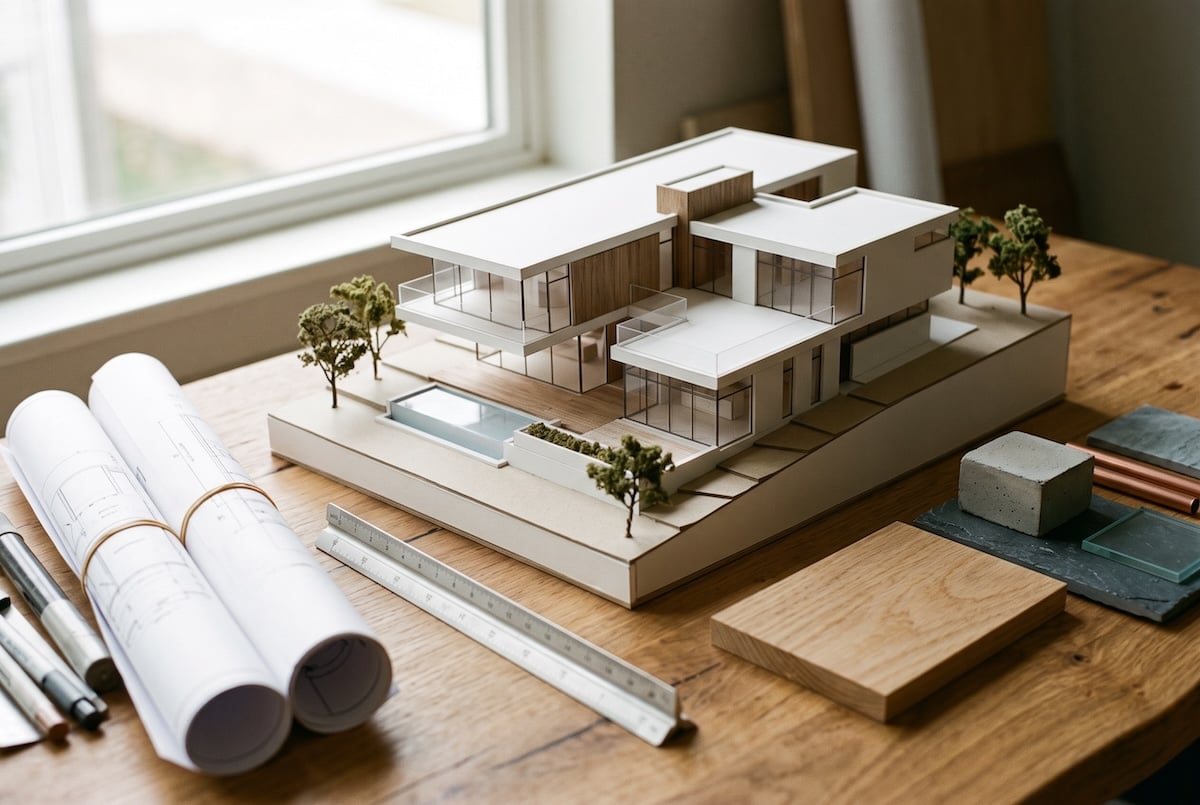
Design-build firms fund that work in different ways. Some carry the cost inside construction, some charge for design separately. Ours is a separate paid phase, $15,000 to $26,000 on a custom home and reduced by 55% if you already hold stamped, permit-ready plans, because it involves feasibility work, site measurement, full 2D and 3D drawings and a cost analysis run against the design before a construction contract exists. Either structure can work. What you want to know is what the phase actually delivers, and whether the drawings and the budget are developed together.
Ask what happens if you complete design and decide not to build. A firm with a clean answer has thought about it. You can see the sequence we use in our design and build process.
Ask what their project minimum is
Most established firms have one. Ask for it directly, and treat a clear answer as a positive signal.
A project minimum tells you what a firm is built to deliver. The fixed costs of running a project properly – design, engineering, permitting, dedicated project management, licensed trades, insurance, warranty – do not shrink with the size of the job. Below a certain budget those costs eat the share that should be going into your actual construction.
The important question is not whether the minimum is high or low. It is whether your project sits comfortably inside the range where that firm does its normal work, rather than at the very bottom or the very top of it.
Judge the portfolio on scope, not style
Style is the easiest thing to change and the thing everyone evaluates. Scope is the hard thing and almost nobody checks it.
What you are looking for is evidence they have completed projects of your type, complexity and value repeatedly. A firm with twenty beautiful kitchen remodels has not demonstrated it can manage a whole-home renovation you are living through, or a ground-up build with a septic system and a difficult grade. Those are different disciplines.
Concretely:
- Ask to see projects at your budget level, not their most photogenic work
- Ask how many projects of your specific type they completed in the last two years
- Ask them to tell you about a project where something significant went wrong and how they resolved it. Every builder has one. How a firm handled a real problem tells you more than ten smooth jobs
- Visit an active site if you can. A well-run site is visibly well-run
Check how they communicate once construction starts
This determines your experience more than any other factor, and it is the hardest thing to assess before you hire.
Ask specifically:
- What software do you use, and will I have a login? A project management platform gives you a schedule, photo log, selections tracker and change-order history you can see rather than ask about. We run projects through BuilderTrend, and clients get their own portal access to it
- Who is my single point of contact, and who covers when they are out
- How often will I get an update, and in what form
- How do change orders work, and will I see the price before or after the work happens
- What is your warranty, and what does it exclude
The change-order question is the revealing one. The answer should be that nothing gets built without written approval of the cost first. If the answer is a shrug, expect surprises. The full contract-side version of these questions lives in our post on what to ask before you sign a construction contract.
Look for third-party proof
Anyone can describe themselves as a premier builder. Look for signals that came from outside the company:
- Trade association membership, such as the National Association of Home Builders, a state home builders association, or a local home builders association chapter. Membership is not a quality guarantee, but it means the firm operates in the open among peers
- Reviews with substance, on more than one platform, that read like real projects with real timelines
- Awards or press attributable to a named organization and year, not a vague badge
- Longevity. A firm that has survived a downturn has been tested in a way a two-year-old company has not
CoCreations has been building in the Triangle since 2013. We are a member of the National Association of Home Builders, the North Carolina Home Builders Association, and the Home Builders Association of Durham, Orange and Chatham Counties, and we take part in the Professional Remodelers Council of North Carolina and Professional Women in Building of the Triangle.
On the awards side, our work has been recognized in the Remodelers Outstanding Construction Awards in consecutive years: three Gold awards in 2025 for Best Home Addition, Best Kitchen and Best Attic/Basement, and 2024 wins for Best Major Renovation and Best Bathroom Renovation. We were also named Best Residential Builder and Best Kitchen Designer in the 2023 Best of Durham Awards.
The signals that should make you walk away
- Pressure to sign quickly, or a discount that expires
- A bid materially below every other bid. Someone has either misread the scope or is planning to find it in change orders
- Unwillingness to name the license classification
- No written scope of work before a construction contract
- A large deposit demanded before any design work exists
- Cash-only, or reluctance to provide insurance certificates
- Vagueness about who is actually on site every day
What we would want you to ask us
If you called us tomorrow, the questions we would most want you to ask are the license classification one, the change-order one, and the reference-from-a-project-that-went-wrong one. They are the three that separate firms, and the three most homeowners never raise.
If you want to see how we answer them, book a free design consultation. No obligation, and you will leave with a rough estimate range rather than a sales pitch.
More on the services we offer and how our process runs.
Frequently Asked Questions
What should I check first when choosing a design-build firm?
The license classification. In North Carolina a general contractor license caps the value of any single project: Limited up to $750,000, Intermediate up to $1,500,000, Unlimited with no cap. Confirm the classification legally covers your project value before anything else.
Is it normal for a design-build firm to charge a design fee?
Yes. Some firms charge separately for design while others incorporate the cost elsewhere in the project. More important than the fee structure is what the design phase produces before construction begins: plans, scope, selections and a budget developed together.
What is a project minimum and why does it matter?
The smallest project a firm will take. Fixed costs like design, engineering, permitting and project management do not shrink with job size, so below a certain budget they consume the money that should be going into construction. A clear minimum is a sign of a firm that knows what it delivers well.
How do I know if a firm can handle my project size?
Ask how many projects of your specific type, complexity and value they completed in the last two years. Twenty beautiful kitchens do not demonstrate the ability to manage a whole-home renovation or a ground-up build.
What are the biggest warning signs when hiring a builder?
Pressure to sign fast, a bid far below all others, unwillingness to name the license classification, no written scope of work before contract, a large deposit before design exists, and reluctance to supply insurance certificates.
Do I need a licensed contractor for a small renovation?
In North Carolina, any project costing $40,000 or more requires a licensed general contractor under state law.

Ready to price your own project?
We design and build custom homes, additions and whole-home renovations across the Triangle. Tell us what you have in mind and we will walk you through scope, timeline and realistic numbers.


