


Home Remodeling Project Planning
How Much Does a Primary Bathroom Remodel Cost in the Triangle?
A primary bathroom remodel in the Triangle runs from around $28,000 for a same-layout refresh to $220,000 and up for a fully custom suite with walls moving. Two things decide where you land, and they are separate: how much you change, and what quality goes back in.
This post is written for substantial primary suite work rather than a cosmetic refresh, because that is where the decisions actually get interesting. The ranges below cover the full spread, so you can place yourself in them either way.
What actually determines the price
Most cost articles give you one range and leave you guessing where you sit in it. There are two variables, and you need both.
Variable one: scope, or how much you change
| Scope | What it means |
| Same-layout renovation | Fixtures stay where they are. New tile, vanity, lighting, paint, glass. |
| Gut remodel | Everything out, new layout inside the existing walls. Plumbing largely stays in its zones. |
| Structural reconfiguration | Walls move, the footprint changes, or plumbing relocates. |
Before major structural reconfiguration, a primary bathroom typically starts within a $35,000 to $115,000 base construction range, depending on room size and how much of the room you are changing. Structural changes are added on top of that, not folded into it. A secondary bathroom in the same project runs $25,000 to $75,000, which is why homeowners often do two together.
Variable two: finish level, or what goes back in
Finish level is not a separate menu of add-ons. It changes the cost of everything in the room, so it moves that whole base range up or down.
| Finish level | What it covers | Primary bath range |
| Light | Cosmetic-grade selections. Stock vanity, standard tile, catalog fixtures. | $28,000 to $97,750 |
| Standard | Quality stock and semi-custom. Good tile, solid-surface tops, name-brand fixtures. | $35,000 to $115,000 |
| Full custom | Bespoke cabinetry, slab stone, custom glass and metalwork, specialty fixtures. | $52,500 to $218,500 |
The spread inside each row is room size and scope. The gap between rows is selections. A large bathroom at light finish and a small one at full custom can land in the same place, which is why a single number quoted without a finish level tells you very little.
Structural work and soft costs then get added on top of whichever row you are in. That is the part worth walking through properly.
What that looks like on one real scope
A primary bath expanding into an adjacent closet, full-custom finish, plumbing relocating:
| Line | Low | High |
| Mid-range primary bath at full-custom finish | $112,500 | $142,500 |
| Moving the wall (structural) | + $5,000 | + $25,000 |
| Relocating electrical, plumbing and HVAC | + $10,000 | + $30,000 |
| Hard costs | $127,500 | $197,500 |
| Design, engineering and permits (8% to 12%) | + $10,200 | + $23,700 |
| Total | $137,700 | $221,200 |
That is how a bathroom reaches six figures. Not through expensive faucets. Through scope plus finish level plus the structural and soft costs that follow them.
Where the money actually goes
This is the part worth understanding, because it tells you where to spend and where to hold back.
Interior finishes are the largest single cost component in residential construction. National data from the National Association of Home Builders’ Cost of Constructing a Home study puts interior finishes at 24.1% of total construction cost, ahead of framing, foundations and mechanical systems. Within that, cabinets and countertops are 4.5% and flooring 3.6%. Those are national new-construction averages rather than Triangle remodeling data, but they illustrate how heavily residential construction costs are driven by interior finishes.
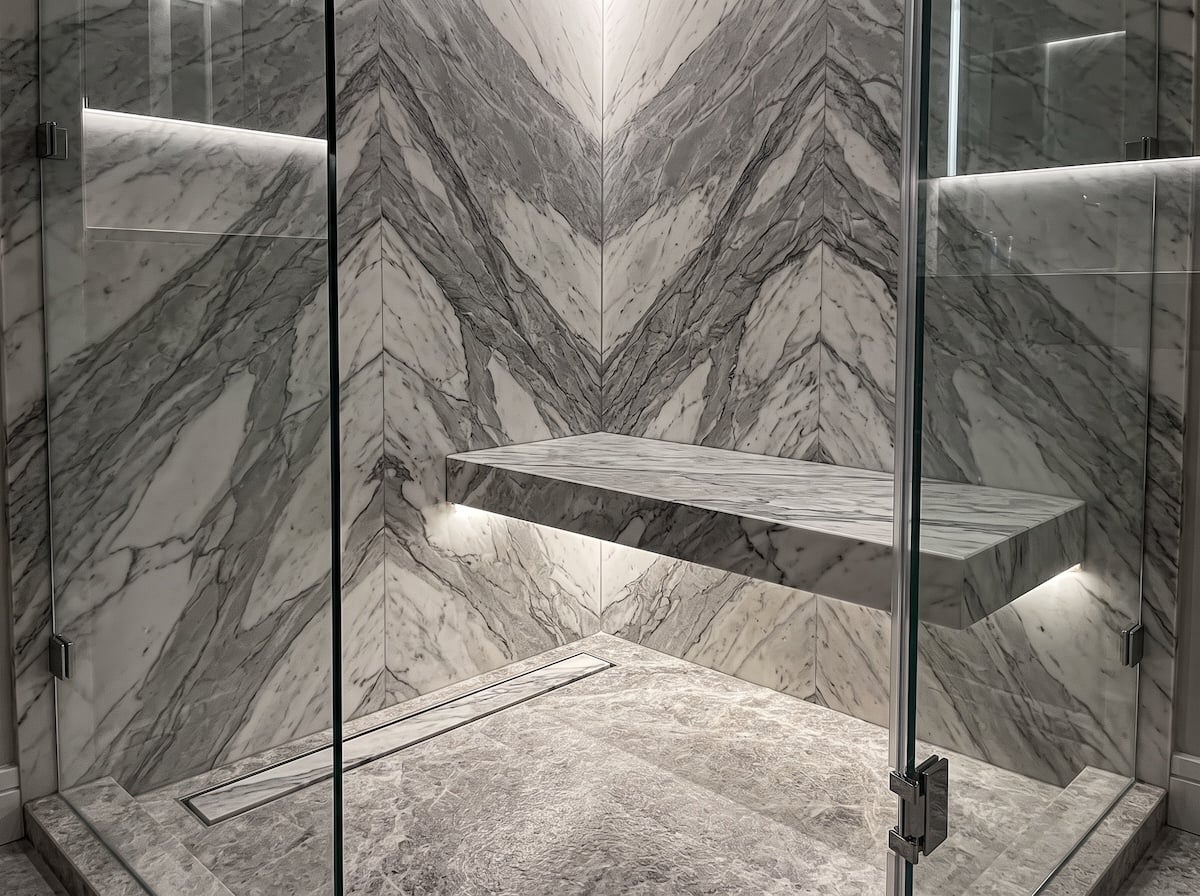
A bathroom concentrates all of it into one small room. That is the whole reason a bathroom costs multiples per square foot of what a bedroom costs. In a space smaller than most bedrooms you have:
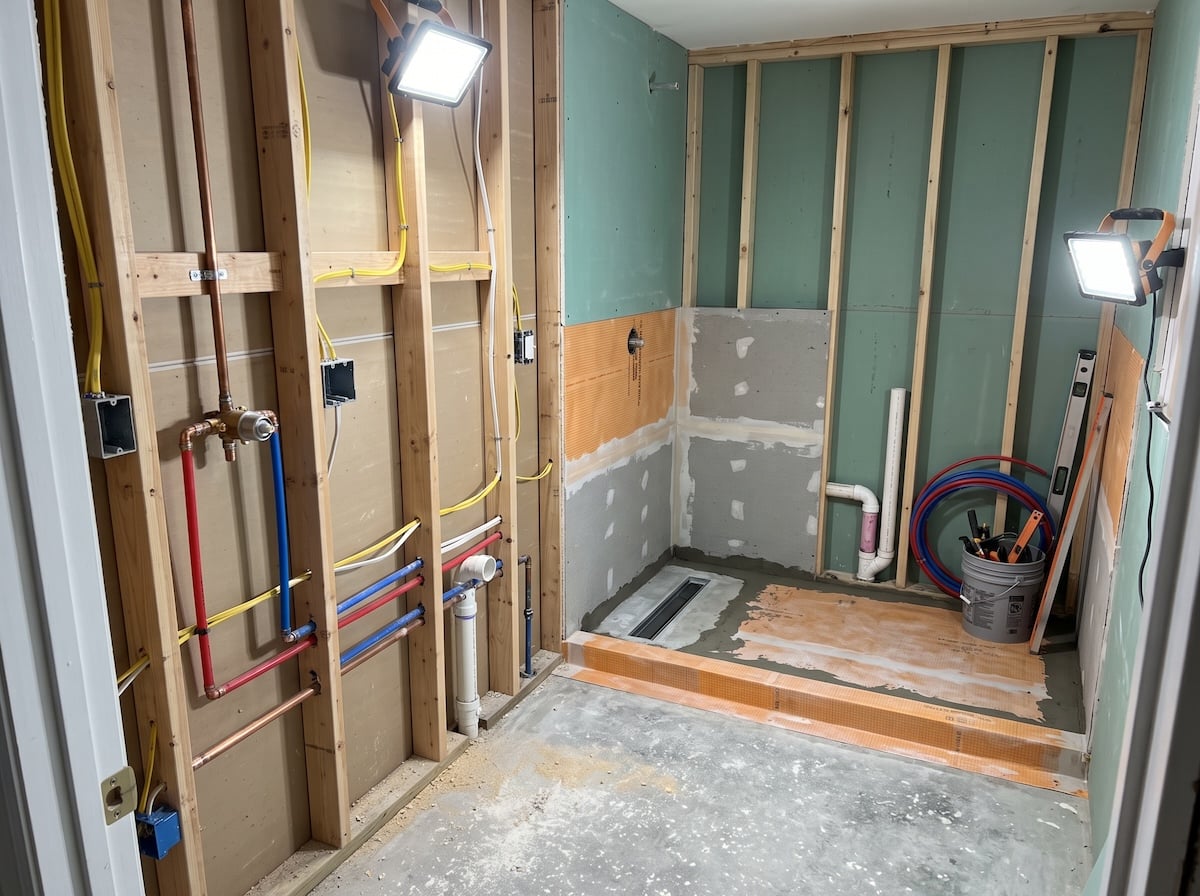
- Waterproofing and substrate work that must be perfect, because failure is invisible until it is expensive
- Plumbing rough-in, supply and drain, often relocated
- Electrical for lighting layers, heated floors, ventilation and often a dedicated circuit
- Mechanical ventilation sized and ducted properly to the exterior
- Tile work, which is labor-dense and unforgiving
- Cabinetry and stone, the two most expensive material categories per square foot in the house
- Glass, which on a custom shower is fabricated to the opening after framing
None of that scales down with room size. A small bathroom and a large bathroom need the same waterproofing sequence and the same number of trades.
What pushes a primary bath into six figures
Moving or removing walls
Expanding a primary bath into a closet, a hallway or an adjacent bedroom costs $5,000 to $25,000 in structural work alone, before any finish. If the wall is load-bearing, you are adding a header or beam and the number moves to the top of that range. It is one of the most common reasons a bathroom budget moves up a bracket, and it is often worth it when the existing layout is the actual problem.
Relocating plumbing
Fixtures cost less than moving them. Electrical, plumbing and HVAC modification on a renovation runs $10,000 to $30,000. Moving a toilet or shower drain across a joist bay is a structural and plumbing job, not a plumbing job.
Adding a bathroom rather than renovating one
A new bathroom needing fresh rough-in adds $12,000 to $35,000 on top of the finish cost, for supply lines, drainage, venting and often a subpanel circuit.
Slab stone and custom fabrication
Natural stone is where full-custom budgets separate from standard. Slab countertops, a slab shower bench, full-height slab walls, book-matched veining and mitered edges all carry both material and fabrication cost. A single well-chosen slab feature reads as luxury more than five scattered upgrades do.
The comfort systems
Heated floors, a steam shower, a freestanding tub with a floor-mounted filler, custom frameless glass, integrated niche lighting and a properly designed ventilation strategy. Each one is modest on its own. Specified together they are what separates a full-custom bathroom from a standard one, and they are the reason two bathrooms of identical size can differ by a wide margin.
For the construction detail behind the details, our post on shower niche and bench design covers how those elements are actually built.
The costs people forget
Design and permits: 8% to 12% of hard costs. On a $150,000 bathroom that is $12,000 to $18,000. This is not padding. It covers drawings, engineering where structural work is involved, permit fees and inspections. Skipping it is how unpermitted work ends up disclosed at resale.
Selections take longer than construction. Not a line item, but the most common cause of a stalled project. Custom vanities, specialty tile and stone slabs all carry lead times. We front-load selections in our design and build process for exactly this reason.
Contingency. Opening walls in an existing home reveals things. Old galvanized supply lines, undersized venting, prior water damage, framing that was never right. Budget for it rather than being surprised by it.
Why a small bathroom costs more per square foot than a big one
This is the part that surprises people, and it explains something useful about renovation pricing generally.
The fixed costs of running a renovation properly – design, engineering, permitting, dedicated project management, licensed trades, insurance, warranty coverage – do not shrink with the size of the room. A 40 square foot powder room and a 200 square foot primary suite need the same permit, the same drawings, the same waterproofing sequence and the same trades turning up. Spread across less space, those costs land harder per square foot.
Which is why combining work usually gives you more for the money. A primary bath done alongside a secondary bath, a closet reconfiguration or adjacent renovation shares the design, the permitting, the mobilization and the trade scheduling across a bigger scope.
Where we would tell you to spend it first
If the budget is finite, and it always is, this is the order we would defend:
- Layout. Fixing a bad layout is the only change you cannot make later. Spend here first, even at the cost of finishes.
- Waterproofing and substrate. Invisible, and the only failure mode that destroys everything above it.
- Ventilation. An undersized or improperly ducted fan will ruin a beautiful bathroom within five years.
- The one stone feature. One slab moment beats a scatter of upgrades.
- Lighting layers. Cheap to do at rough-in, expensive to add afterwards.
- Fixtures and finishes. Genuinely swappable in ten years. Everything above is not.
When you are comparing a materially cheaper quote, look carefully at what is allocated to layout work, waterproofing and ventilation. Those are easy places for scope differences to hide, because you do not see them in the finished photos.
Ready to talk real numbers?
Every figure here is a range because every house is different. What your bathroom costs depends on your existing layout, whether walls need to move, what condition the plumbing is in, and what you actually want.
Our bathroom work won Best Bathroom Renovation in the 2024 Remodelers Outstanding Construction Awards, so the standard described above is the one we actually build to.
Book a free design consultation and we will walk the space, tell you what is straightforward and what is not, and give you a rough estimate range before you spend anything on design.
See what these budgets produce in our bathroom remodel gallery, or read more about our bathroom remodeling services.
Frequently Asked Questions
How much does a primary bathroom remodel cost in the Triangle?
Around $28,000 for a same-layout refresh with light finishes, $35,000 to $115,000 at standard finish, and $52,500 to $218,500 at full custom, all before structural work, design and permits. Scope and finish level are separate variables and you need both to place yourself in the range.
Why do bathrooms cost so much more per square foot than other rooms?
A bathroom concentrates waterproofing, plumbing, electrical, mechanical ventilation, tile, cabinetry, stone and custom glass into a space smaller than most bedrooms. None of that work scales down with room size.
How much does it cost to move walls in a bathroom renovation?
$5,000 to $25,000 in structural work, before finishes. Load-bearing walls sit at the top of that range because they require a header or beam.
What percentage of a bathroom budget goes to design and permits?
8% to 12% of hard costs. On a $150,000 bathroom that is $12,000 to $18,000, covering drawings, engineering, permit fees and inspections.
Should I renovate two bathrooms at once?
Often yes. A second bathroom in the same project runs $25,000 to $75,000 at standard finish, less than doing it separately later, because design, permitting, mobilization and trade scheduling are shared.
What should I prioritize if my budget is limited?
Layout first, then waterproofing, then ventilation. Those three are the changes you cannot make later. Fixtures and finishes are genuinely swappable in ten years.

Ready to price your own project?
We design and build custom homes, additions and whole-home renovations across the Triangle. Tell us what you have in mind and we will walk you through scope, timeline and realistic numbers.


